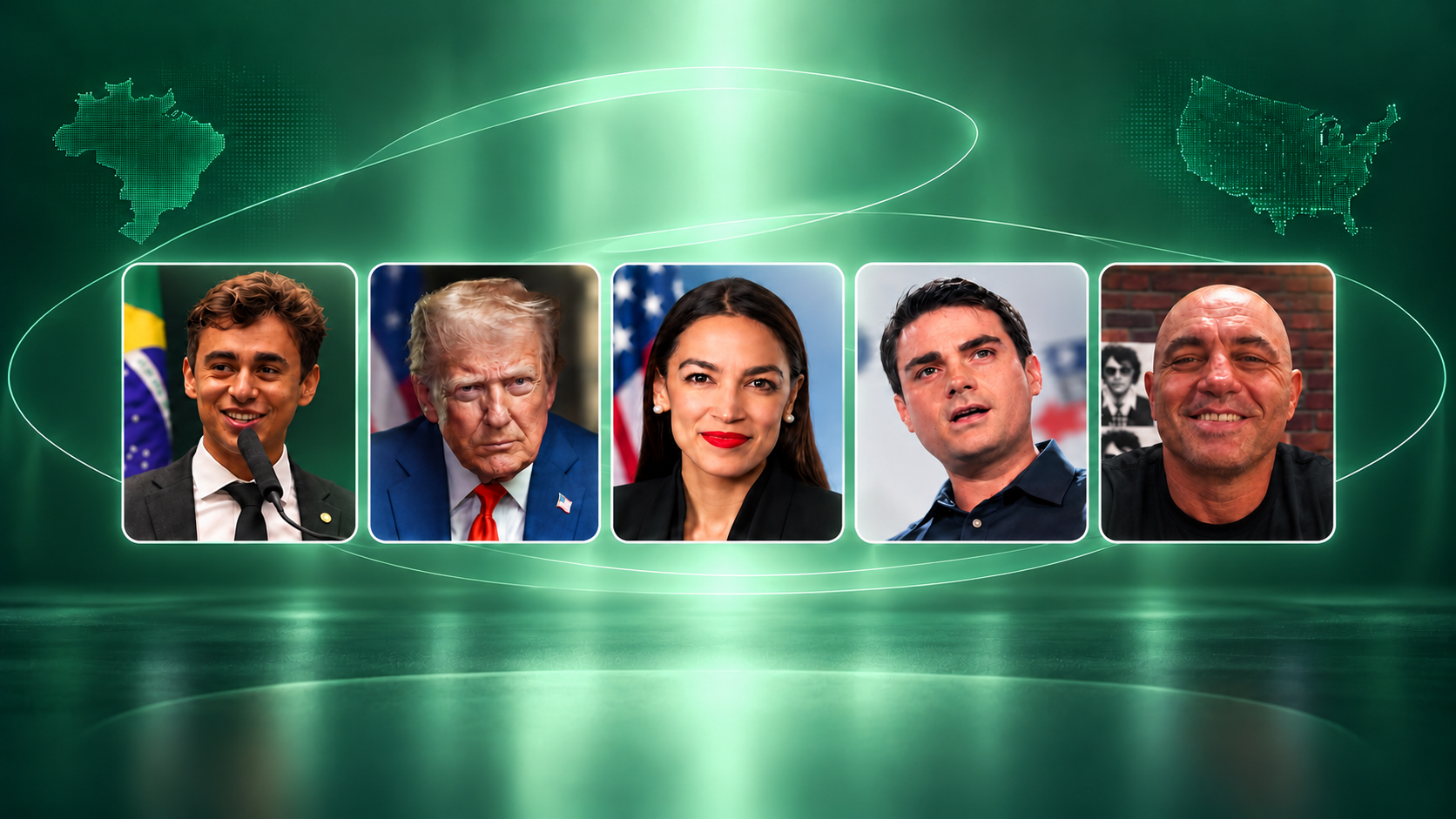
A short clip can become the whole conversation.
A two-hour interview and a 30-second excerpt are different experiences. A clip selects a moment, often leaving the surrounding questions, qualifications and responses outside the frame. In Brazil, these excerpts are commonly called cortes. They circulate through Reels, YouTube Shorts, TikTok and private sharing.
The relevant comparison between Brazil and the United States is how speakers, editors, media hosts and recommendation systems interact. A prominent account or one viral video cannot establish that one country is more digitally advanced than the other.
180 Reels. Six selected accounts.
Jaguo collected public view counts for 30 recent, non-pinned visible Instagram Reels from each of six selected profiles on October 20, 2026. Individual publication dates were checked. The samples include all Reel topics and formats, not only political excerpts. Means and medians were calculated from displayed counters; figures below are approximate.
Nikolas Ferreira had the largest mean and median in this selection. His mean remained approximately 32.6 million after removing the highest-viewed Reel. This describes the selected account and observation window; it does not establish unique audience, persuasion, electoral influence or the cause of distribution.
Selected political accounts
| Account | Mean views | Median views | Publication period |
|---|---|---|---|
 Nikolas Ferreira@nikolasferreiradm | 33.9M | 31.8M | Sep 14 – Oct 19, 2026 |
 Alexandria Ocasio-Cortez@aoc | 1.99M | 1.35M | Jun 21 – Oct 16, 2026 |
 Ted Cruz · Senate account@sentedcruz | 40.1K | 24.7K | Jul 22 – Oct 7, 2026 |
 Donald Trump@realdonaldtrump | 4.72M | 3.00M | Sep 27 – Oct 19, 2026 |
Media hosts, shown separately
| Account | Mean views | Median views | Publication period |
|---|---|---|---|
 Joe Rogan · personal Instagram@joerogan | 3.25M | 1.70M | Oct 1, 2025 – Oct 11, 2026 |
 Ben Shapiro@officialbenshapiro | 379K | 287K | Oct 6 – Oct 19, 2026 |
30 Reels per account. Approximate cumulative public views. Publication periods differ; dates use America/New_York.
The account is not the whole media operation.
Alexandria Ocasio-Cortez’s sample covers nearly four months; Nikolas Ferreira’s covers a little over one month. Older videos have had more time to accumulate views. The samples also differ in subjects, collaborations, audiences and posting frequency.
Ted Cruz is represented by his institutional Senate account, @sentedcruz. These figures do not measure his personal accounts or the audience of Verdict. Joe Rogan’s personal Instagram is not JRE Clips on YouTube; his 30-Reel sample spans more than a year. Ben Shapiro is included as a commentator and media host, separately from elected officials.
The accounts were deliberately selected as examples. They are not a representative sample or a verified ranking of the largest political clip producers.
There are two selections before the audience responds.
An editor chooses which words become the excerpt. A recommendation system helps select who encounters it. Accounts and private sharing add further distribution paths. Comments, reposts and edited reactions can change the framing again.
YouTube describes recommendations informed by viewing history, feedback and satisfaction surveys. Meta Engineering describes Facebook Reels recommendations incorporating direct user feedback alongside other signals. These platform descriptions are not one universal formula and do not explain the performance of any individual political video.
Originality policies also matter. Meta’s March 2026 Facebook guidance distinguishes original or substantively transformed material from low-value reuploads. Rules for Facebook should not be treated as identical rules for Instagram or YouTube. The view-count sample cannot determine whether distribution was organic, paid, coordinated or driven by a particular recommendation signal.
2028: more automation inside familiar channels.
A plausible scenario is wider use of AI to help identify excerpts, generate subtitles, translate speech and summarize longer exchanges within today’s video and messaging ecosystems. Reels and long-form interviews could continue to coexist while the selection and presentation of excerpts become more automated.
The research question is whether that changes access to context, accuracy and the information people actually encounter. More output or higher view counts alone would not establish better understanding or a change in voting behavior. Adoption, platform rules and applicable regulation remain conditions, not fixed assumptions.
2030: an assistant may interpret the conversation first.
A further scenario is a larger role for personal assistants that compare proposals, summarize debates and select sources before users watch the original material. The Reuters Institute’s 2026 trends report discusses AI-mediated news access and personalized briefings. Its industry expectations should not be read as measured voter adoption or an election forecast.
This could add another intermediary between the original speaker and the citizen: a system that selects evidence and frames an explanation. Whether it becomes widespread by 2030 is uncertain. Source visibility, correction mechanisms and public trust would affect its usefulness.
IFES’s Brave New Ballot report also highlights risks to democratic trust from generative AI. As synthetic material becomes easier to produce, authentic records may face greater suspicion. Verifiable origin helps establish provenance; it does not prove that a statement is true.
Two election cycles, different institutions.
In 2028, Brazil holds municipal elections and the United States holds a presidential election. In 2030, Brazil holds general elections, including the presidency, while the United States holds midterm elections. These are comparison horizons, not claims that the technologies will reach a particular level on a particular date.
Looking ahead to the 2028 and 2030 elections, what will most influence how people form political opinions and decide how to vote: politicians’ own words, the clips they encounter, or how AI and platforms frame those messages?
A new viral case, outside the sample.
On October 20, Nikolas Ferreira published “O Nordeste que foi esquecido.” GP1 reported more than 100 million Instagram views within approximately eight hours; Folhapress also reported that the post exceeded 100 million views. These are reported counts at the time of coverage, not a live counter independently verified by Jaguo.
The audio was removed during the video’s circulation, not necessarily before those views accumulated. According to Meta’s statement reported by Folhapress, the removal followed a copyright request. The available evidence does not establish how many views occurred before or after the removal, or whether the controversy increased distribution.
The episode adds a question to this study: how much of a political video’s circulation comes from the message itself, and how much comes from the conversation around it? Recommendation, sharing and platform enforcement can shape the viewing experience, but this case alone does not isolate their effects.
This video was published after the Nikolas sample’s October 19 cutoff. It is a separate case update and has not been added to the 30-Reel mean or median. Views are not unique viewers and do not establish persuasion or voting effects.
Case update: October 21, 2026. GP1, October 20 · Folhapress / Jornal de Brasília, October 20.
Method and data
Counts are cumulative, rounded public views at collection, not exact Insights, unique people, engagement rates or equal-age video performance. All Reel topics, promotions and collaborations appearing in the sampled grids were retained. A pinned June 2024 video on @aoc was excluded. No validated video-by-video classification of political clips versus original short videos was completed. Sample periods shown use America/New_York; the U.S. dataset stores UTC publication dates. Missing, deleted, hidden or subsequently published content may change the visible sample. These observations cannot establish causal algorithmic favoritism, organic versus paid distribution, or voting effects.
Download 150 U.S. observations (CSV) · Download 30 Nikolas observations (CSV)
Sources
- Instagram profiles and post-level dataset
- Alexandria Ocasio-Cortez
- Ted Cruz · Senate
- Donald Trump
- Joe Rogan
- Ben Shapiro
- YouTube: How recommendations work
- Meta Engineering: Facebook Reels and user feedback
- Meta: Rewarding Original Creators on Facebook
- Reuters Institute: Trends and Predictions 2026
- IFES: Brave New Ballot
- USAGov: Presidential election process
- USAGov: Midterm elections
Image credits
Nikolas Ferreira: Câmara dos Deputados, institutional profile photograph. Alexandria Ocasio-Cortez: Franmarie Metzler / U.S. House Office of Photography, public domain. Ted Cruz: U.S. Senate press kit. Donald Trump: Daniel Torok / White House, public domain. Joe Rogan: Steven Crowder, 2017, CC BY 3.0, via Wikimedia Commons. Ben Shapiro: Gage Skidmore, 2016, CC BY-SA 3.0, via Wikimedia Commons. Portraits cropped for layout. No endorsement implied.
Nikolas photo · Alexandria photo · Ted Cruz photo · Trump photo · Rogan photo · CC BY 3.0 · Shapiro photo · CC BY-SA 3.0


The cropped Ben Shapiro photograph is available under CC BY-SA 3.0.