SpaceX + Tesla: A Strategic Fit. At What Price?
Jaguo Insights | October 22, 2026 | Business strategy, capital allocation and governance
The potential combination has an understandable industrial logic. Whether it creates value depends on what shareholders pay, what integration actually improves and which risks come with it.
A credible strategy still needs a transaction case
The discussion around a possible SpaceX–Tesla combination is moving from speculation toward process. Reuters reports that independent committees are examining a transaction, but no price or exchange ratio has been agreed. Possible structures reportedly include SpaceX acquiring Tesla or a new holding company. None should be treated as the settled outcome. Reuters, October 22
For business leaders, the useful question is what common ownership would accomplish that existing commercial agreements cannot.
A shared leader, overlapping technology and an ambitious vision can explain why two businesses want to work together. An acquisition must also explain why combining ownership is the best way to do so. That distinction is the starting point for Jaguo’s assessment.
The strategic argument: connect infrastructure with applications
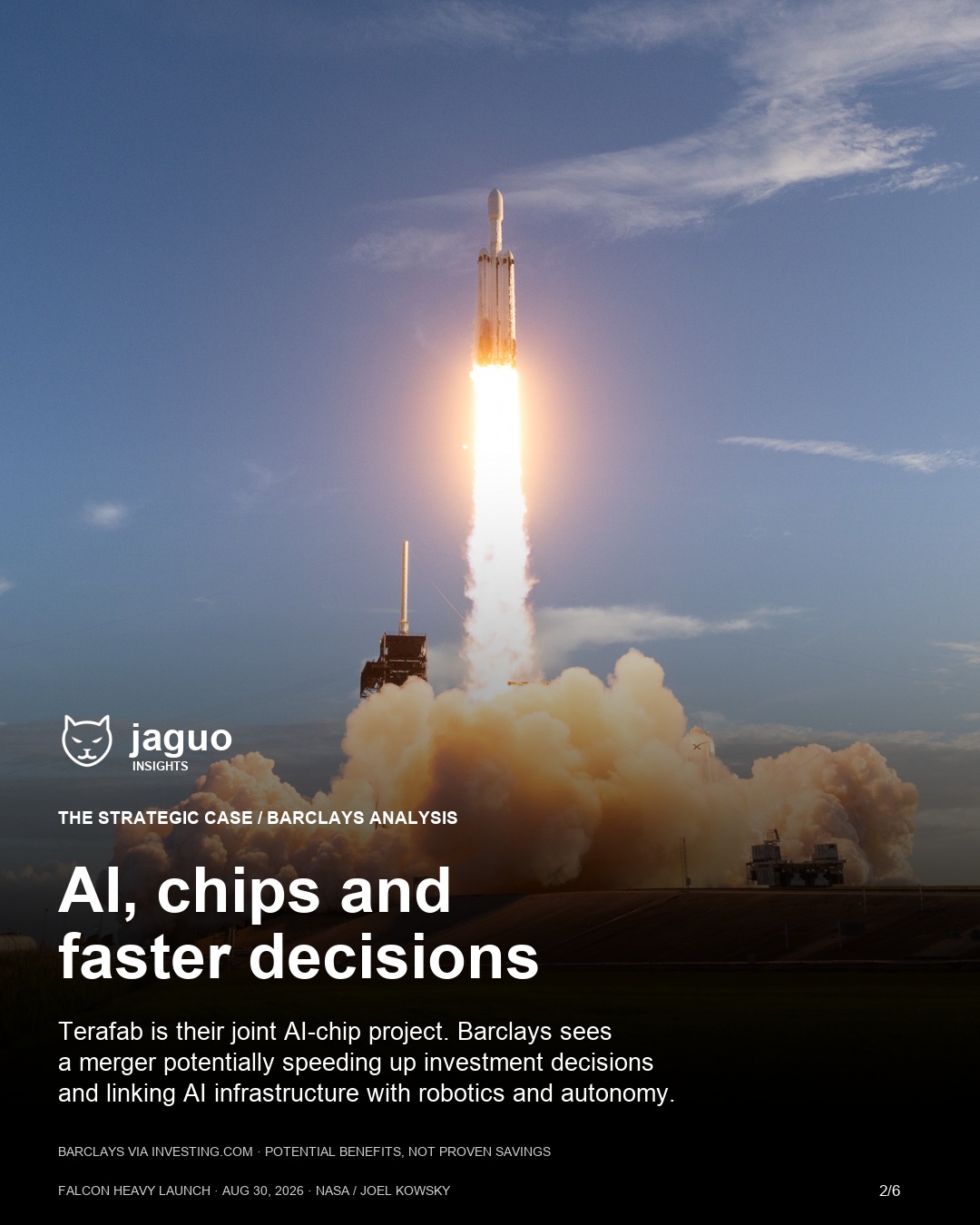
Barclays analyst Dan Levy sees a potential combination as an AI integration strategy: connecting SpaceX’s infrastructure and AI activities with Tesla’s robotics and autonomous systems. Terafab, their joint AI-chip initiative, is one example. The bank also points to the possibility of faster decisions when projects no longer require separate corporate approval processes. These are potential benefits, not demonstrated merger savings. Barclays analysis, reported by Investing.com
There is an operating argument here. Shared ownership could make it easier to align engineering priorities, coordinate capital spending and resolve disagreements about where resources should go. When several businesses depend on a common technology platform, separate budgets can introduce delays or conflicting incentives.
But integration introduces its own trade-offs. A central budget can accelerate a promising project while making it harder to see whether each business earns an adequate return. Sharing resources is useful only if the combined allocation is better than what the companies could achieve independently.
The practical test is to identify specific bottlenecks, explain how ownership removes them and estimate the resulting benefit. “We can move faster” is a hypothesis to measure, not a valuation by itself.
The financial contrast behind the discussion
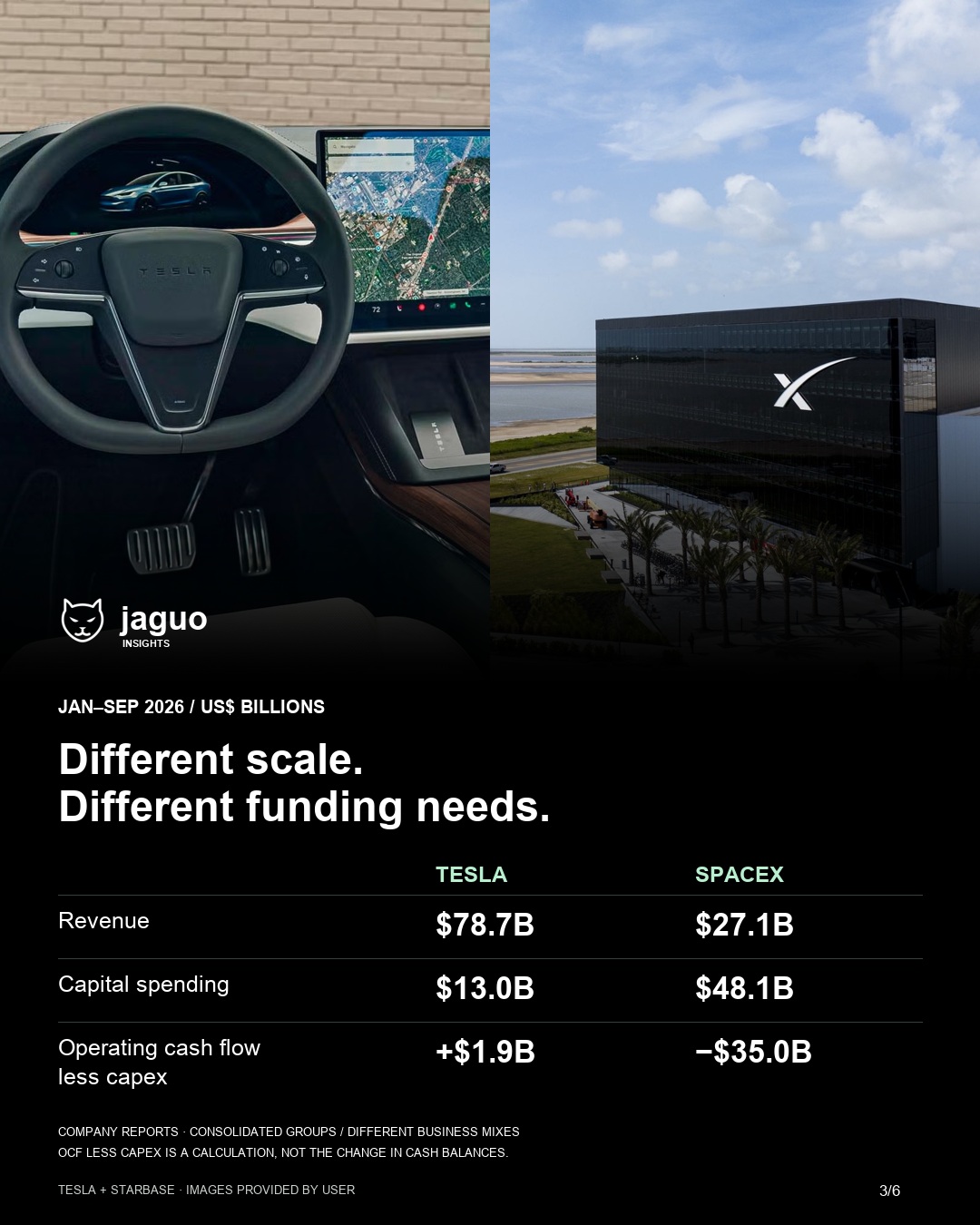
The nine-month figures show two different relationships between operating scale and investment. The comparison below uses consolidated company reports, with Tesla’s flow figures calculated by adding its three reported quarters.
January–September 2026 | US$ billions, rounded
| Metric | Tesla | SpaceX |
|---|---|---|
| Revenue | 78.7 | 27.1 |
| Capital expenditure | 13.0 | 48.1 |
| Operating cash flow | 14.9 | 13.1 |
| Operating cash flow less capex, calculated | +1.9 | −35.0 |
Tesla produced approximately 2.9 times the revenue, while SpaceX invested approximately 3.7 times as much in capital expenditure. These ratios are Jaguo calculations from the reported figures. Sources: Tesla Q3 update, SpaceX filed Q3 release.
The gap makes financing and capital allocation important questions. It does not establish that either company requires a merger. Operating cash flow less capex is also not a change in cash balances: financing, acquisitions and other investing activity affect the final balance.
At September 30, cash, equivalents and current investments totaled approximately $45.4 billion at Tesla and $89.9 billion at SpaceX. Reported debt and finance leases totaled approximately $9.5 billion and $38.8 billion, respectively. Sources: Tesla, SpaceX.
The resulting analytical question is whether combining the businesses would improve the cost, availability or productivity of capital enough to justify the transaction. Moving money between businesses does not automatically create value. The projects receiving that money must still generate attractive returns.
Price determines how the benefits are shared
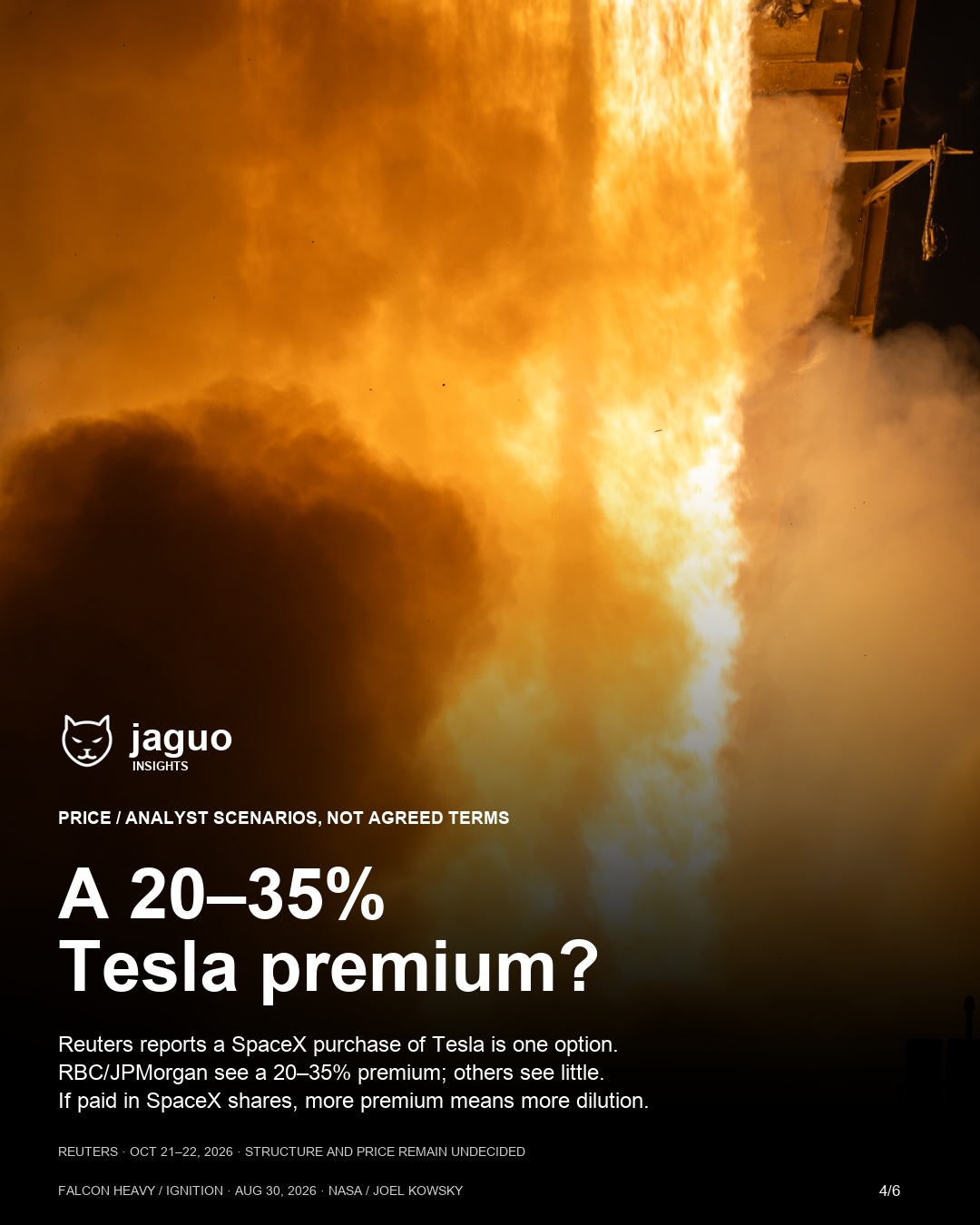
Reuters reports that RBC and JPMorgan expect Tesla investors to seek a premium of 20% to 35%, while other investors anticipate little or none. These are competing expectations, not offers. The disagreement illustrates why strategic enthusiasm cannot settle the exchange ratio. Reuters, October 21
In a hypothetical acquisition paid entirely in newly issued SpaceX shares, a higher price for Tesla would require issuing more shares, all else equal. Existing SpaceX shareholders would own a smaller percentage of the combined business. Tesla shareholders would receive a larger share of the combined opportunity.
Dilution in percentage ownership is not automatically destruction of economic value. Issuing shares can be worthwhile if the assets and benefits received exceed what is given up. The danger is paying for benefits that arrive late, cost more than expected or would have been available through a partnership.
Our transaction framework is therefore:
Incremental merger benefits − integration costs − additional risks − acquisition premium.
This is a conceptual framework, not a completed valuation. A defensible model would estimate the timing and probability of cash flows, avoid double-counting existing collaboration and test alternative exchange ratios. No valuation target is implied here.
Governance: evaluate the transaction from both sides
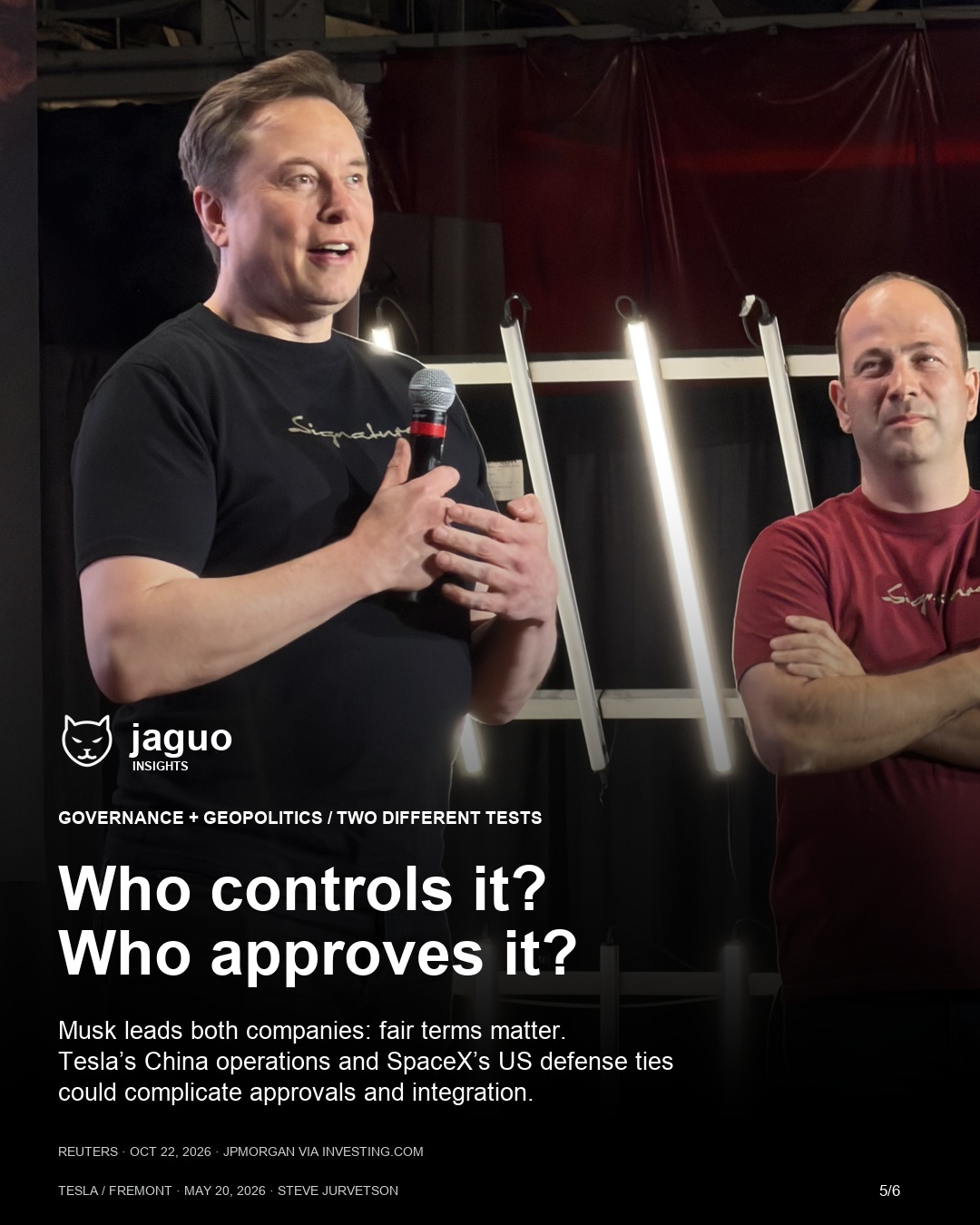
Musk’s leadership of both companies makes the quality of the process particularly important. Reuters reports that the discussions are early-stage and that Musk has acknowledged his conflict. Columbia law professor Eric Talley emphasizes the importance of transaction terms in assessing possible disputes. Reuters, October 22
A useful review must ask whether each shareholder group would accept the terms if it were represented by a fully independent negotiator. The same strategic story can support very different distributions of value.
Investors should examine the valuation methods, alternatives considered, independence of advisers and the proposed voting structure. Economic ownership and voting control are separate questions. Neither a combined ownership percentage nor a control estimate can be treated as final before the securities and exchange terms are known.
Geopolitics could limit the integration thesis
JPMorgan analyst Rajat Gupta identifies China as a major obstacle, given Tesla’s operations there and SpaceX’s US defense connections. A structure separating the China business is one possibility discussed in the bank’s analysis, rather than an announced company plan. JPMorgan analysis, reported by Investing.com
Reuters also cites Bruegel researcher Alicia Garcia-Herrero on the risk that a formal combination makes it harder for Chinese authorities to treat Tesla as a purely commercial actor. Reuters on geopolitical exposure
This creates a tension inside the business case. If safeguards require separation of data, technology, personnel or decision-making, they may reduce some of the benefits used to justify common ownership. Approval and value creation cannot be modeled independently: the permitted structure helps determine which synergies are achievable.
What would make the case stronger—or weaker?
| Evidence to watch | What it would tell us |
|---|---|
| Specific benefits unavailable through contracts | Whether ownership solves a real coordination problem |
| Quantified savings and implementation costs | Whether the integration has a credible financial payoff |
| Exchange ratio and valuation assumptions | How the opportunity and risks are divided |
| Regulatory conditions and operational safeguards | How much integration is actually possible |
| Capital budgets and return milestones | Whether investment is disciplined after the deal |
| Independent process and alternatives analysis | Whether both shareholder groups received a fair assessment |
The case becomes stronger if measurable operating benefits survive conservative cost assumptions and realistic restrictions. It becomes weaker if most of the claimed value comes from activities already underway, depends on optimistic technology timelines or requires a premium unsupported by incremental returns.
There is also an execution test after any approval. Management would need to demonstrate that the new organization improves decisions without obscuring accountability. Separate reporting of major investment programs, milestones and operating results would help investors distinguish progress from a broader corporate narrative.
The Jaguo view
The potential strategic fit deserves serious examination. AI infrastructure, chip development, robotics and autonomy can create genuine coordination needs. Our analysis does not assume that existing cooperation makes a merger unnecessary; common ownership might improve its depth and speed.
But the financial contrast does not prove the transaction is necessary, and a compelling industrial vision does not establish a fair price.
The strategy is easier to explain than the price. The test is whether additional benefits outweigh the premium, integration costs and risks—on terms that work for both shareholder groups.
Method and source notes
Information cutoff: October 22, 2026. Reported facts, attributed analyst views and Jaguo’s analytical judgments are distinguished throughout. Bank views were accessed through reporting on their notes, not the complete original research reports. No final deal structure, price, exchange ratio or closing date is assumed.
Flows cover January 1–September 30, 2026; balances are at September 30. Amounts are rounded from US$ millions. Tesla nine-month revenue, operating cash flow and capex were calculated by adding Q1–Q3 figures in its Q3 update. SpaceX figures use its nine-month reporting column. The consolidated groups have different business mixes and acquisition histories.
Cash reserves include cash, equivalents and current marketable or short-term investments; they should not be interpreted as funds freely available for any purpose. Debt includes finance leases at carrying value and excludes operating leases. Operating cash flow less capex is Jaguo’s simple calculation, not a harmonized company-defined free-cash-flow measure or a change in cash balances.
The Instagram visual briefing
The six slides accompanying this analysis. Select any image to open it at full size.
Visual credits: Falcon Heavy photographs, NASA/Joel Kowsky, August 30, 2026. Musk photograph, Steve Jurvetson, May 20, 2026, CC BY 4.0 (cropped, gradient/text added). Tesla interior and Starbase photographs supplied by the publisher; original photographer and reuse terms were not supplied. Brand compositions by Jaguo Insights. Context photographs do not depict merger negotiations.
Jurvetson source · CC BY 4.0 · NASA album ·